


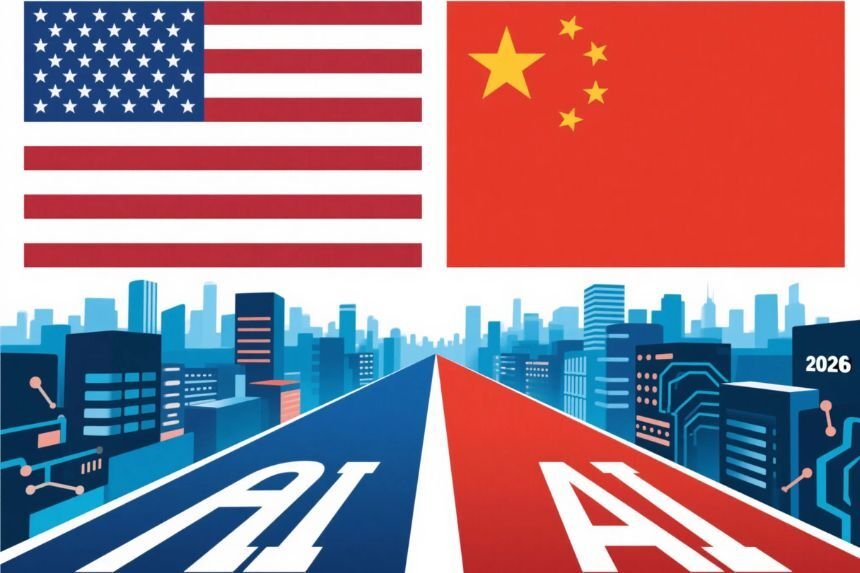
In 2026, the rivalry between the United States and China over artificial intelligence and advanced technology has reached a point where simple scorekeeping no longer works. This is not a single race with one finish line. Instead, it is a complex competition unfolding across multiple fronts: AI models, semiconductors, power grids, military systems, industrial automation, critical minerals, and global alliances.
- The AI Race Is Already Global and Intertwined
- Chinese AI Models Inside U.S. Companies
- Two Different AI Business Philosophies
- Military AI: Speed Versus Bureaucracy
- Chips: America’s Core Strength and Bottleneck
- Power Infrastructure: The Decisive Factor
- Critical Minerals: Strategy Over Tariffs
- Allies Under Pressure
- Industrial AI: Where China Pulls Ahead
- Risks Beneath the Surface
- What the Next Five Years Could Look Like
- Final Assessment: Who’s Winning in 2026?
- Frequently Asked Questions (FAQs)
Each country is winning some battles and losing others. The United States still dominates cutting-edge semiconductor design and frontier AI research. China, meanwhile, excels at scaling technology quickly, integrating AI into factories and military systems, and building the infrastructure needed to deploy AI in the real world.
The question in 2026 is no longer “Who has the smartest AI?” but “Who can use AI fastest, cheapest, and at the largest scale?”
The AI Race Is Already Global and Intertwined
One of the biggest misconceptions about the US–China tech rivalry is the idea that the two ecosystems are fully separated. In reality, they remain deeply entangled.
American companies rely on Chinese manufacturing. Chinese firms rely on Western chip designs. And increasingly, U.S. platforms are quietly relying on Chinese AI software.
This interdependence complicates policy decisions and blurs the idea of a clean technological divide.
Chinese AI Models Inside U.S. Companies
Quiet Adoption in Everyday Products
Despite political tensions, Chinese AI models are already embedded in U.S. consumer platforms. Companies such as Pinterest and Airbnb have adopted models from Chinese developers, including Qwen and DeepSeek, for tasks like product recommendations, search ranking, and customer support automation.
These decisions are not ideological. They are commercial.
Executives point to faster inference speeds, lower operating costs, and strong performance in real-world usage rather than benchmark tests.
Cost Matters More Than Prestige
One of the clearest advantages Chinese AI models offer is cost. In many enterprise deployments, Chinese models are reported to be up to 90 percent cheaper than comparable offerings from U.S. providers such as OpenAI or Google.
For large platforms handling millions of queries per day, cost differences of this magnitude can determine profitability.
Accuracy also plays a role. In applied settings such as shopping recommendations or customer service classification, some Chinese models reportedly outperform U.S. alternatives by roughly 30 percent.
Open-Source Momentum
Chinese AI firms have embraced open-source distribution as a strategic weapon. On platforms like Hugging Face, Chinese models frequently rank among the most downloaded in the world.
Alibaba’s Qwen family has reportedly surpassed hundreds of millions of downloads, at times exceeding Meta’s LLaMA ecosystem in usage. This widespread adoption creates developer familiarity and long-term lock-in, even when companies publicly claim neutrality.
Former Meta executive Nick Clegg has highlighted the contrast: U.S. firms often restrict access to protect revenue, while Chinese firms prioritize reach and ecosystem dominance.
Two Different AI Business Philosophies
The U.S. Model: Control and Monetization
In the United States, AI development is dominated by a small number of companies operating closed or semi-closed systems. Access to advanced models is typically gated behind APIs, subscriptions, or enterprise contracts.
This approach supports safety controls, quality assurance, and shareholder returns. However, it also slows mass adoption and limits experimentation outside well-funded organizations.
The Chinese Model: Scale First
Chinese firms generally prioritize rapid deployment and wide access. By offering powerful models cheaply or openly, they encourage experimentation across startups, factories, universities, and government agencies.
This strategy sacrifices short-term profits in exchange for scale, data, and influence—an approach that mirrors China’s earlier success in telecommunications and manufacturing.
Military AI: Speed Versus Bureaucracy
The Pentagon’s Wake-Up Call
In January 2026, the U.S. Department of Defense issued a stark warning: future wars would be decided by which military learns and applies AI fastest.
This led to a series of “AI-first” initiatives aimed at accelerating experimentation and deployment. These projects focus on autonomous coordination, battlefield decision support, logistics optimization, and large-scale war simulations.
The Pentagon also introduced new rules requiring military units to replicate successful AI projects within weeks rather than years. Oversight boards were established to bypass traditional procurement bottlenecks.
Structural Challenges Remain
Despite these reforms, the U.S. military still struggles with bureaucracy. Procurement rules, contractor oversight, and inter-service rivalry slow progress.
Even when AI tools work well in testing, scaling them across the force remains difficult.
China’s Military-Civil Fusion Advantage
China approaches military AI from a fundamentally different angle. Its Military-Civil Fusion strategy integrates private technology companies directly into defense planning and execution.
Chinese AI firms routinely sell tools straight to the People’s Liberation Army without the lengthy approval processes seen in the U.S. system.
Studies of thousands of Chinese defense contracts show private firms playing an increasingly central role in surveillance systems, autonomous platforms, decision-support software, and cyber operations.
AI-Driven Cyber Warfare
One of the most striking differences is in cyber operations. Analysts estimate that a large majority of China’s cyberattacks are now conducted by AI systems with minimal human oversight.
Automation allows China to launch attacks at a scale and speed that human teams cannot match. It also complicates attribution, increasing the risk of escalation.
Chips: America’s Core Strength and Bottleneck
Nvidia and the Frontier Advantage
The United States still leads decisively in advanced semiconductor design. Nvidia’s top-tier AI chips remain unmatched in performance, particularly for training large models.
Export controls have limited China’s access to the most advanced chips, forcing Chinese firms to rely on older or modified designs.
Export Controls Have Limits
Despite restrictions, Chinese companies continue to acquire advanced chips through indirect channels, stockpiling, and domestic substitutes.
At the same time, U.S. chip dominance matters less if models can run efficiently on cheaper hardware. Chinese AI developers have focused heavily on optimization, squeezing performance out of less advanced chips.
Power Infrastructure: The Decisive Factor
AI Runs on Electricity
AI systems consume enormous amounts of power. Training large models and running data centers at scale requires reliable, abundant electricity.
This is where the U.S. faces a growing disadvantage.
America’s Grid Constraints
The United States has announced hundreds of billions of dollars in planned data center investments. However, many projects are delayed by grid congestion, aging infrastructure, and slow permitting processes.
In some regions, data centers cannot connect to the grid for years.
China’s Energy Build-Out
China is rapidly expanding its power generation capacity. By the end of the decade, it is expected to have hundreds of gigawatts of surplus electricity available.
Much of this capacity is earmarked for AI training, robotics, electric vehicles, and industrial automation.
In practical terms, China can deploy AI faster simply because it has the power to run it.
Critical Minerals: Strategy Over Tariffs
Trump’s Shift in Approach
In early 2026, President Trump surprised markets by avoiding sweeping tariffs on Chinese rare earths and lithium. Instead, the administration focused on supply security through strategic stockpiling and allied coordination.
The $2.5 Billion Stockpile
A new U.S. critical minerals stockpile was created with a mandate similar to a central bank. It can stabilize prices, support domestic mining, and counter Chinese market dominance.
The stockpile is governed by an independent board and can purchase minerals at above-market prices to sustain supply.
Domestic Processing Investments
The Pentagon has also invested in domestic processing facilities, including funding the first large-scale U.S. gallium plant. Gallium is essential for advanced chips, radar systems, and missile guidance.
China currently controls most global gallium production, making this investment strategically significant.
Allies Under Pressure
Japan and Australia Act Independently
Japan has responded to Chinese export restrictions by launching deep-sea mining projects for rare earths. Australia has built strategic reserves of critical minerals to reduce dependence on Chinese supply chains.
Canada’s China Pivot
Canada has moved closer to China through expanded trade discussions covering uranium, oil, and gas. This has alarmed U.S. officials, particularly as Canada considers easing tariffs on Chinese electric vehicles.
Greenland and European Tensions
Renewed U.S. interest in Greenland’s mineral resources has strained relations with Denmark and the European Union. These tensions complicate efforts to coordinate a unified Western minerals strategy.
Despite export controls, China’s rare earth exports have continued to rise, highlighting how deeply global supply chains still depend on Chinese processing capacity.
Industrial AI: Where China Pulls Ahead
Factories, Robots, and Logistics
China is rapidly integrating AI into factories, warehouses, ports, and logistics networks. Robotics and automation are deployed at scale, not as pilot projects.
This “physical AI” advantage matters because it translates directly into productivity, cost reduction, and export competitiveness.
The U.S. Software Edge Isn’t Enough
The United States leads in software innovation, but without equivalent manufacturing scale, many AI advances remain confined to digital products rather than physical systems.
Risks Beneath the Surface
Shadow AI Use
A large share of U.S. workers now use unapproved AI tools in daily work. These tools often lack security vetting, creating risks for sensitive data and critical infrastructure.
Escalation Risks
China’s reliance on automated cyber operations increases the risk of rapid escalation. AI-driven attacks can spiral faster than human decision-makers can respond.
What the Next Five Years Could Look Like
Several futures remain possible.
The United States could regain momentum if military reforms succeed, infrastructure investment accelerates, and alliances hold together.
A more likely outcome is a split world, where the U.S. dominates frontier AI research while China leads in industrial and applied AI.
The most disruptive scenario would see a full technological bifurcation, with countries forced to choose between competing AI ecosystems.
Final Assessment: Who’s Winning in 2026?
There is no clear winner.
The United States leads in chips and frontier research. China leads in deployment speed, power availability, and real-world integration.
The true AI race is not about intelligence but execution. The country that can build infrastructure, secure minerals, generate power, and deploy systems at scale will shape the future.
For now, China has the edge in making AI real. Whether it keeps that advantage will depend on how quickly the United States can modernize its grid, streamline deployment, and keep its allies aligned.
Frequently Asked Questions (FAQs)
- Why are U.S. companies using Chinese AI models?
Because many Chinese models offer strong real-world performance at significantly lower cost. In high-volume applications, cost and speed often matter more than brand origin.
- Are Chinese AI models as good as U.S. models?
In many applied tasks, Chinese models match or outperform U.S. models. While the U.S. still leads in frontier research, the gap in practical use is much smaller than often assumed.
- Why doesn’t the U.S. just block Chinese AI completely?
Because supply chains, software ecosystems, and global businesses remain deeply interconnected. Full decoupling would be costly and disruptive.
- Is power really more important than chips?
Yes. Without electricity, AI systems cannot run. China’s power surplus gives it a major advantage in scaling AI deployment.
- What is Military-Civil Fusion?
It is China’s strategy of integrating private technology companies directly into military development, allowing faster deployment of new tools.
- Will allies stay aligned with the U.S.?
That remains uncertain. Economic pressures are pushing some countries to hedge between Washington and Beijing.
- Who is likely to win by 2030?
The most likely outcome is a split victory: the U.S. leading frontier AI research, and China leading large-scale, real-world AI deployment.
Lorem ipsum dolor sit amet, consectetur adipiscing elit. Ut elit tellus, luctus nec ullamcorper mattis, pulvinar dapibus leo.