


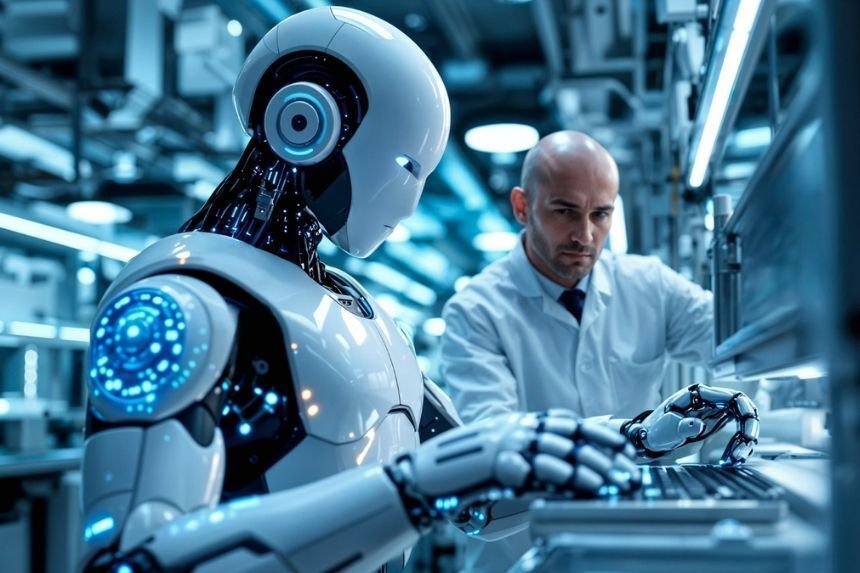
For much of 2023 and 2024, AI lived behind text boxes.
Chatbots drafted emails, summarized meetings, and answered questions rapidly.
- The rise of physical AI
- What this article covers
- What is physical AI?
- How it differs from previous AI
- Why 2026 is the tipping point
- Technology convergence
- How physical AI works
- Market size, growth, and sectors
- Leading sectors
- Robots and cobots
- Physical AI in action
- Social and media reactions
- Strategic implications for businesses
- Risks, ethics, and governance
- Beyond 2026: the road ahead
- FAQs: Physical AI and 2026
By 2026, that era is clearly ending across industries and homes.
At CES, in warehouses, hospitals, vehicles, and living rooms, AI is no longer only talking.
It is sensing, deciding, and acting directly in the physical world around people and objects.
The rise of physical AI
This shift marks the rise of physical AI in everyday systems and spaces.
These are intelligent machines and environments that perceive surroundings and take meaningful actions.
AI is moving beyond an interface layer and becoming operational, embodied, and infrastructural for organizations.
What this article covers
This article explains what physical AI is and why 2026 is a tipping point.
It explores how the technology works, where it is deployed, key risks, and implications for businesses and society.
What is physical AI?
Core definition
Physical AI refers to systems inside robots, devices, or environments that sense the physical world and act within it.
These systems operate in three‑dimensional space, interacting with people, objects, and changing conditions.
How it differs from previous AI
Chatbots and LLMs
Chatbots and large language models mostly work through text or voice.
They live in digital environments and rely on user prompts to respond.
Traditional robots
Traditional industrial robots follow predefined scripts for repetitive tasks.
They often struggle when conditions change unexpectedly or when objects vary.
Physical AI systems
Physical AI combines robotics with advanced perception, planning, and learning.
Such systems can adjust to new situations, recover from errors, and collaborate safely with humans nearby.
A simple example
A warehouse robot navigating around people and recognizing damaged packages in real time illustrates physical AI clearly.
It detects damage, reroutes intelligently, and acts independently, not waiting for step‑by‑step commands.
Clarifying the terminology
Many discussions blur terms like “robots,” “embodied AI,” “agentic AI,” and “chatbots.”
The key differentiator is real‑world agency: physical AI closes the loop from perception to action.
Why 2026 is the tipping point
CES 2026 as a signal
Reports from CES 2026 suggest AI has moved from flashy demos to quiet infrastructure.
Many impactful products did not loudly advertise “AI inside”; they simply performed essential tasks reliably.
Humanoids, helpers, and platforms
Humanoid and semi‑humanoid robots appeared across logistics, manufacturing, and home assistance.
Healthcare robots supported staff with delivery and monitoring duties around hospitals.
Vehicles increasingly appeared as autonomous platforms, not just connected cars with digital assistants.
This reflected a shift from chatbot announcements toward AI that physically operates in complex environments.
Technology convergence
Cheaper compute and better sensors
Several forces converge to make 2026 a genuine inflection point.
Computing has become cheaper and more efficient for on‑device and edge AI workloads.
Sensors such as cameras, depth sensors, LiDAR, tactile arrays, and IMUs now provide richer perception.
Simulation and reinforcement learning
Simulators and reinforcement learning pipelines allow robots to train safely in many scenarios.
This reduces risk and speeds learning before robots enter real facilities.
Vision‑language‑action models
Vision‑language‑action models translate high‑level instructions into grounded behaviors.
They connect language, vision, and control so systems act appropriately in specific contexts.
From “can AI do this?” to “what does AI enable?”
Individually, these components are not entirely new.
Together, they push physical AI from experimental pilots to commercially viable systems.
Industry voices increasingly frame AI as infrastructure rather than a standalone feature.
The central question becomes what new capabilities AI unlocks in the real world.
How physical AI works
Sensing and perception
Physical AI begins with rich perception using multiple sensor types.
Cameras, LiDAR, depth sensors, microphones, and inertial units capture continuous information about environments.
Computer vision models detect objects, people, and layouts in the scene.
Sensor fusion combines different signals to stay robust under noise or changing conditions.
From language models to vision‑language‑action
Language models still handle reasoning and communication tasks.
They help interpret instructions, summaries, and human feedback.
Physical AI also uses models that connect perception with real‑world actions.
Vision‑language‑action models interpret instructions like “move the damaged box to inspection.”
These models link language, visual context, and motor commands to drive behavior.
Planning and control
Planning components decide how to reach goals safely and efficiently.
Motion planners compute paths, while policies adapt behavior under uncertainty and constraints.
Safety layers and constraints prevent collisions and dangerous movements around people or equipment.
Simulation environments let robots learn navigation, grasping, and collaboration before deployment.
Hardware and edge compute
Physical AI must respond quickly within strict power and latency limits.
On‑device GPUs and accelerators provide real‑time decision‑making without constant cloud access.
This reduces dependence on connectivity and improves resilience and privacy.
A simple loop describes the process: sense, understand, plan, and act, repeated frequently.
Market size, growth, and sectors
Global and US market
Analysts estimate the global physical AI market near USD 5 — 5.4 billion in 2025.
Projections suggest growth to about USD 49–61 billion by 2033–2034.
That implies compound annual growth around 31–32% over the period.
In the United States, the market may grow from about USD 1.5 billion in 2025 to around USD 14 billion by 2033.
Logistics automation, advanced manufacturing, and healthcare systems drive much of this demand.
Leading sectors
Warehousing and logistics
Warehousing and logistics heavily adopt autonomous mobile robots and picking systems.
Manufacturing
Manufacturing introduces vision‑guided cobots, flexible assembly cells, and automated inspection lines.
Healthcare
Healthcare uses surgical systems, delivery robots, and rehabilitation devices to support clinicians.
Retail and consumer
Retail and consumer markets feature home robots, smart appliances, and ambient AI in stores and houses.
Robots and cobots
Industrial robots today
Industrial robots currently hold the largest revenue share globally.
Cobots as the fastest‑growing segment
Collaborative robots grow fastest because they work safely near humans and adapt quickly to new tasks.
Amazon’s DeepFleet AI in Warehousing
Amazon deployed its millionth robot across more than 300 global facilities, with DeepFleet AI using real-time data to coordinate movements and cut congestion. Robots support 75% of deliveries worldwide, achieving a 10% gain in travel efficiency that speeds order processing and lowers costs.
BMW’s Autonomous Factory Vehicles
BMW integrates physical AI—sensors, mapping, and planners—for new cars to self-navigate assembly lines to finishing areas without humans, handling dynamic changes precisely. This scales global production safely amid shifting schedules, though specific stats like throughput gains are not quantified in the source.
Waymo and Aurora in Autonomous Transport
Waymo completed over 10 million paid robotaxi rides using vision-language-action models for urban adaptation. Aurora launched the first commercial self-driving trucks for regular Dallas-Houston freight, marking production-scale reliability in logistics
Physical AI in action
Warehousing and logistics
Large logistics providers operate fleets of autonomous mobile robots inside warehouses.
These robots handle picking, sorting, and transport between storage and packing stations.
Case reports describe noticeable reductions in worker walking distance and higher order throughput.
Robots address labor shortages by automating movement, while humans manage exceptions and oversight.
Healthcare and hospitals
Hospitals increasingly deploy robots for medication delivery, sample transport, and rehabilitation support.
These systems reduce staff time spent on routine errands and internal logistics.
Surgical robots support minimally invasive procedures by enhancing precision and stability.
Some studies associate these systems with smaller incisions and shorter recovery in specific surgeries.
Manufacturing and cobots
Manufacturers mount vision‑guided cobots on assembly, packaging, and inspection lines.
Cobots detect part orientation, adjust to variations, and stop safely when humans approach.
Compared with fixed automation, cobots enable faster changeovers for new products or variants.
This flexibility benefits electronics, automotive components, and consumer goods manufacturers.
Consumer and home
CES 2026 showcased home helper robots combining navigation, manipulation, and conversational interfaces.
AI‑powered cleaning systems and context‑aware appliances adjust behavior based on occupancy and environment.
Many offerings remain early‑stage and premium in price.
However, focus is shifting from spectacle toward reliable, repeatable usefulness in everyday homes.
Social and media reactions
Hype and skepticism
Social media commentary around CES 2026 reveals mixed reactions.
Many users feel excited about robots that “finally do something useful” beyond chatting.
Viral clips of humanoid robots walking, lifting, or interacting attract intense attention.
Awkward failures fuel skepticism about reliability and realistic deployment timelines.
Expert and influencer perspectives
Experts and founders often emphasize that successful physical AI should feel almost invisible.
The best systems quietly improve logistics, cleaning, and patient flow without demanding attention.
Analysts warn against assuming stage demos equal real‑world readiness.
They highlight gaps between controlled exhibitions and messy daily environments.
Strategic implications for businesses
Choosing where to start
Organizations exploring physical AI must choose starting points carefully.
Most begin with focused pilots in controlled areas such as internal logistics lanes or single production cells.
Build versus buy
Build‑versus‑buy decisions heavily influence outcomes.
Many companies rely on robotics platforms and integrators, focusing internally on workflows and change management.
Skills and roles
Deployments require new skills and roles inside organizations.
Teams often include robotics engineers, field technicians, AI operations staff, and safety specialists.
Five questions for leaders
Leaders evaluating investments can start with five questions.
Which task offers clear ROI and measurable outcomes?
Can the system integrate with existing processes and software?
Who carries responsibility for safety and liability?
What data, monitoring, and maintenance will the system require?
How will human roles change and improve around automation?
Risks, ethics, and governance
Safety and jobs
Physical AI introduces risks that text‑only systems never faced.
Safety and liability become central when robots share space with workers, patients, or customers.
There are legitimate concerns about job displacement in repetitive roles.
Outcomes depend on whether organizations redesign work or focus only on cost reduction.
Security and privacy
Security problems can have physical consequences for people and infrastructure.
Compromised robots or sensor networks may cause harm or create serious privacy violations.
Regulation and standards
Regulatory frameworks and technical standards are still evolving around autonomous systems.
Early adopters must treat governance, cybersecurity, and ethics as core design constraints from the start.
Beyond 2026: the road ahead
Short‑term trajectory
In the short term, physical AI will spread through pilots and incremental improvements.
Hardware costs should decline and reliability should increase as deployments mature.
Long‑term ecosystem
Over longer timeframes, the ecosystem may split into two broad categories.
One focuses on narrow, task‑specific robots; the other aims at more general‑purpose humanoids.
Convergence with spatial computing
Physical AI will increasingly intersect with spatial computing and augmented reality platforms.
That convergence will blur lines between digital interfaces and physical environments.
A structural shift beyond chatbots
Ultimately, “beyond the chatbot” is more than a slogan.
It reflects a structural shift in where AI creates value, moving from screens into systems, spaces, and infrastructure.
FAQs: Physical AI and 2026
- What is the difference between physical AI and traditional robots?
Physical AI uses advanced perception, planning, and learning to act in changing environments, not only repeat fixed motions.
Traditional robots usually follow scripted routines and struggle when objects, layouts, or tasks change unexpectedly.
- How is physical AI different from chatbots and LLMs?
Chatbots and LLMs live in digital space and mainly produce text or voice responses to prompts.
Physical AI systems sense the real world and take physical actions with robots, devices, or machines.
- Why is 2026 considered a turning point for physical AI?
Multiple trends converge in 2026: cheaper computers, better sensors, and stronger simulation and learning tools.
Events like CES 2026 showcase many robots and embodied systems moving from demos to practical products.
- Which industries are adopting physical AI first?
Early adoption is strongest in warehousing, logistics, manufacturing, and healthcare.
Retail, consumer devices, and smart homes are following with helper robots and ambient systems.
- Will physical AI replace human workers?
Physical AI often automates repetitive, physically demanding tasks such as walking long distances or moving goods.
Impact on jobs depends on whether organizations redesign roles for higher‑value work or focus mainly on headcount reduction.
- How big is the physical AI market expected to become?
Estimates place the global market around USD 5–5.4 billion in 2025.
Forecasts suggest growth to roughly USD 49–61 billion by 2033–2034, with about 31–32% annual growth.
- Is physical AI safe to use around humans?
Safety depends on robust sensors, conservative control policies, and strict testing.
Standards and regulations are still evolving, so careful design and monitoring remain essential.
- What are the main risks of physical AI?
Key risks include collisions, malfunctioning hardware, and security issues from compromised robots or sensors.
There are also concerns around job displacement and privacy due to continuous data collection in shared spaces.
- How can a business start with physical AI?
Businesses usually begin with small pilots in controlled areas such as single warehouses or production cells.
They often partner with robotics platforms or integrators and focus internally on workflows, change management, and safety.
- What technologies enable physical AI?
Core components include sensors, computer vision, planning algorithms, reinforcement learning, and specialized hardware for edge computation.
Newer models like vision‑language‑action systems help connect instructions, perception, and physical control.