

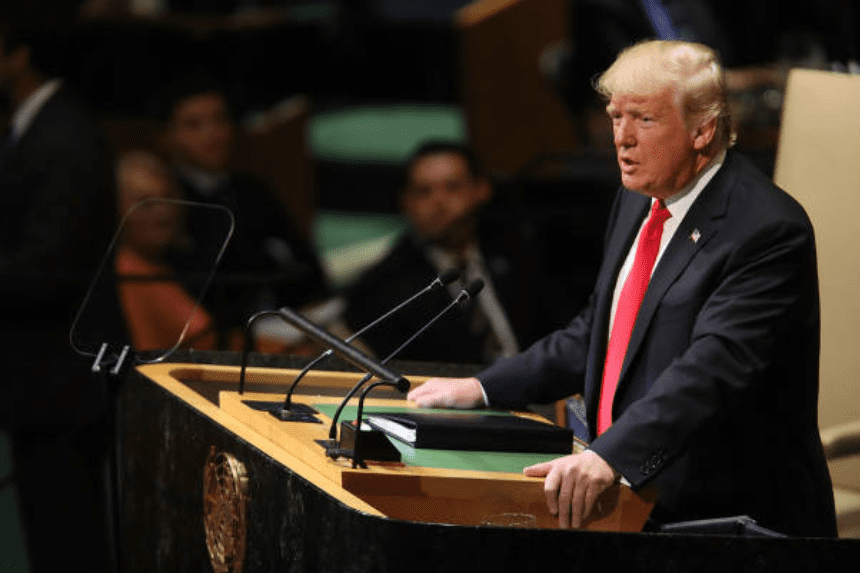
At the 2025 United Nations General Assembly, former US President Donald Trump gave a controversial address, which triggered a global debate. Six years after his comment, with laughter, this year’s Trump United Nations speech was greeted with a particularly different response: silence.
Speaking for about an hour, Trump gave a tremendous defense of nationalism by rapidly criticizing global institutions and prolonged colleagues. His tone was combative and unapologetic, which closely aligned with his ideological brand, which supporters find straightforward, but critics consider the fire. Throughout, he made adventure claims, highlighted his world vision, and emphasized that he believes that global rule is a decline of systems.
What Did Trump Say About the United Nations?
Trump began his speech by questioning the effectiveness of the UN itself. He claimed the institution had “tremendous potential” but failed to deliver tangible results. In his view, the UN had become a body that issues statements instead of solving conflicts.
He singled out the organization’s involvement with asylum seekers, accusing it of contributing to what he called “invasions” at national borders. Trump also mocked the UN for technical glitches during his visit, including a malfunctioning teleprompter and a broken escalator.
His remarks pointed to a deeper skepticism of multilateral diplomacy. Trump argued that peace is achieved through strong leaders making deals—not by relying on bureaucratic international systems. Here is the link to our article on the Trump Tariff Impact.
Why Did Trump Target Europe and Its Policies?
The Trump UN speech also took direct aim at Europe, accusing the continent of making critical errors in energy policy and immigration. He condemned European nations for embracing renewable energy, calling climate change “the greatest con job ever perpetrated on the world.”
He warned that this shift was driving up energy costs and weakening the economy, specifically criticizing the United Kingdom for taxing North Sea oil. Trump argued that abandoning fossil fuels in favor of green energy would cause national failure.
On immigration, he claimed that Europe had been “invaded” by unprecedented numbers of illegal immigrants. He described this as a threat to Western civilization and blamed political correctness for what he sees as Europe’s cultural decline.
What Stance Did Trump Take on Ukraine and Russia?
Turning to the war in Ukraine, Trump issued a veiled warning to Russia. He stated that Vladimir Putin’s ongoing aggression was “not making Russia look good” and suggested a new round of tariffs could be used as leverage.
Interestingly, Trump claimed that some European nations were still buying Russian energy—though data indicates only a few, such as Hungary and Slovakia, continue limited purchases. He avoided criticizing larger buyers like India and China directly.
In a later social media post, Trump hinted for the first time that Ukraine could potentially reclaim all of its territory—with help from the EU and NATO. However, he did not commit to U.S. military support, a stance that raised eyebrows among analysts. Here is the link to our article on Trump Security Suspended.
How Did Trump Frame Religion and Culture?
The cultural undertone of the Trump UN speech was unmistakable. Trump expressed concern for what he sees as the erosion of Judeo-Christian values in the West. He called for the protection of religious liberty and singled out Christianity as the “most persecuted religion” globally.
This sentiment echoed earlier remarks made during his recent UK visit, where he emphasized the preservation of what he called “the English-speaking world.” For Trump, uncontrolled immigration and progressive values represent an existential threat to Western heritage.
Was This Classic Trump or Something New?
Trump’s speech was unmistakably in line with his usual style—direct, provocative, and rooted in nationalist ideology. He dismissed global institutions and environmental policies, insisting that strong nations should lead alone. His closing remark, “Your countries are going to hell,” landed heavily. Unlike past speeches that met with laughter, this one was received in silence.
Final Thoughts
The 2025 Trump United Nations speech strengthened its hallmark subjects of nationalism, suspicion, and cultural conservatism of global institutions. His unpublished tone and direct criticisms attracted both support and condemnation, underscoring his ability to consistently divide international opinion. While he offered very little in terms of the new policy, his comments indicated a clear rejection of multilateral diplomacy. As the world struggles with complex global challenges, Trump’s voice is disruptive, vocal, and impossible to ignore.